|
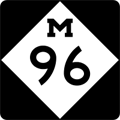
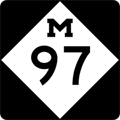
Highways 90 through 99
M-90 | M-91 | M-93 | I-94 | M-94 | M-95 | I-96 | M-96 | M-97 | M-99 | Jump to Bottom
|
|
 |
Western Terminus: |
M-24 six miles west of North Branch in northwestern Lapeer County (cnr North
Branch Rd & Lapeer Rd) |
| Eastern Terminus: |
M-25 in downtown Lexington (cnr
Huron Ave & Main St) |
| Length: |
44.18 miles |
|
Map: |
Route Map of M-90 |
|
Notes: |
A connection with M-57 at Otisville
has been proposed to join the western end of M-90 with the eastern end
of M-57, however this has remained a
dotted line on a map for decades and it is not clear if this connection will
ever be built. |
|
History: |
c.1920 - The first
iteration of M-90 exists in Dickinson Co via the route which would later
become part of M-69. M-90 begins at M-45 (present-day
M-95) six miles south of Sagola and proceeds easterly, ending at Foster City. |
|
|
1926 - The first iteration of M-90 ends when M-69 is rerouted through central
Dickinson Co, completely supplanting M-90 in the process. However, the M-90
designation is immediately transferred to the Lower Peninsula where it replaces
the M-38 designation from M-36 at North Branch to end at M-19 east of Melvin. |
|
|
c.1930 - When M-24 is
extended northerly from Lapeer, M-90 is extended westerly from North Branch
to meet the new highway 12 miles north of Lapeer, or 8 miles south of Mayville. |
|
|
1934 - In late 1934, M-90 is extended by 19 miles
to the Lake Huron shore. From its former eastern terminus at M-19,
M-90 now runs northerly concurrently with M-19 to
Peck, where it turns to run due easterly to its new terminus at US-25 in
downtown Lexington. |
|
|
1956 - Two realignments occur in mid-1956:
- A small realignment runs via
an extension of North Branch Rd to M-53 east
of North Branch. The former route via Marsh & Burnside Rds (west
of M-53) is turned back to
local control.
- The more major change shaves 3 miles from the route, which now
runs due easterly from Brown City to intersect M-19 three
miles south of Peck. The former route via Maple Valley & Galbraith
Line Rds is turned back to local control.
|
|
|
1957 - One year after becoming a part of M-90, the final gravel section
of that highway is paved in Sanilac Co. |
|
|
1965 - The route of M-90 is again shortened, this time by one mile when
a new alignment opens at the highway's western end west of North Branch.
The former route along Fish Creek & Castle Rds is turned back to county
control. |
|
Freeway/Expwy: |
No portion of M-90 is freeway or expressway. |
|
Photographs: |
|
|
Weblinks: |
M-90
@ Michigan Highway Ends - photos of the termini of M-90 at
Dan Garnell's excellent Michigan
Highway Ends website. |
|
 |
Southern Terminus: |
M-44 on the western
edge of Belding |
| Northern Terminus: |
M-46 at Lakeview
(cnr Greenville Rd & Howard City-Edmore Rd) |
| Length: |
24.36 miles |
|
Map: |
Route Map of M-91 |
|
Notes: |
The first Meijer store
(Meijer's Thrift Market) was located on M-91/Lafayette St on the north
side of Greenville in 1934. Until May 2001, Meijer store #001 was still located
on N Lafayette St. However, with a shift of Greenville's shopping focus to
the west side of town along M-57, Meijer closed store #001 on M-91, replacing
it with a newer, larger store along the M-57 west corridor, numbering the
new store #201 in the process. |
|
|
What is today M-91 was once the southernmost portion of M-66 which,
then it met M-46 in Montcalm Co, jogged
west instead of east as it does today and travelled via Greenville and Belding
to its terminus at Lowell. When M-66 was
relocated to its present routing via Stanton and Ionia, the modern day version
of M-91 was created. |
|
History: |
c.1920 - This route starts
its existence in the Upper Peninsula's Menominee Co where M-91 begins
at M-15 (present-day US-41)
in Menominee and continues northeasterly along the shore of Green Bay, ending
in the community of Cedar River. |
|
|
1926 - All of M-91 is supplanted by a southerly
extension of M-35 along the coast from Escanaba to Menominee. Two years would
elapse before the M-91 designation would again appear. |
|
|
1928 - In 1928, the State Highway Dept
assumes control of the road leading from US-23 in
Rogers City northwesterly along the Lake Huron shore to P.H.
Hoeft State Park and designates it M-91. The highway now serves as an access route to
the park from the main highway. |
|
|
1934 - A four mile extension of M-91 along the Lake Huron shore is completed
in late 1938. While M-91 itself would now be considered as a "highway
to nowhere," the extension is actually par t of a project to move US-23 to a shoreline alignment between Rogers City and Cheboygan. Until complete,
however, this portion of the highway retains the M-91 designation. |
|
|
1936-38 - While initial grading and drainage work is done on a 4-mile long
M-91 extension to Ocqueoc Rd, construction is completed in 1938 to gravel-highway
standards. |
|
|
1940 - The gap between the northern end of M-91
near Hammond in Presque Isle Co and the Presque Isle/Cheboygan Co line is
closed when the final stretch of gravel highway officially opens as a reroute
of US-23 along the Lake Huron
shoreline. Because of this, M-91 is once again no longer a state
trunkline designation. |
|
|
1941 - By late 1941, M-91 has now made its way down the Lower Peninsula
to take on a routing abandoned by M-66. When M-66 is realigned to replace
the M-14 designation south of M-46 through Stanton, Ionia and Nashville to
M-78 near Battle Creek, the former routing of M-66 from M-46 at Lakeview
southerly though Greenville, Belding and Lowell to US-16 is redesignated
as M-91. (The six-mile stretch of M-46/M-66 between Six Lakes and Lakeview
becomes just M-46.) |
|
|
1954 - This year saw the paving of the last gravel
stretch of M-91, in Ionia Co. |
|
|
c.1958 - A new western bypass of Belding is completed
and M-91 now continues south directly to M-44,
then easterly via M-44 to its former
route in Belding where it then continued southwesterly toward Lowell. The
former route into downtown Belding is turned back to county and city control. |
|
|
c.1958-59 - M-91 is extended on the south as US-16 is
transferred onto the newly constructed freeway south of Lowell. Once source
shows a staged extension, first by one mile westerly along the former US-16 (Cascade
Rd) to M-50/Alden Nash Ave as the US-16 freeway
is temporarily terminated at M-50. The second stage, according to this source,
is by less than a mile south on the former M-50 (and for a short time, US-16/M-50)
to meet the new US-16 freeway at the M-50 interchange as the freeway is completed
to the west. The second source shows the extension likely occurred all at
once, westerly along the former US-16, then south along Alden Nash to meet
the new freeway. |
|
|
1968 - The four miles of M-91 from jct M-50 & I-96 (at
Exit 52) to M-21 in downtown Lowell
is transferred to Kent Co as a county road. M-91 now terminates at M-21/Main
St in
downtown Lowell. |
|
|
1979 - M-91 becomes one of the few state highways
of "modern times" to
become a two-segmented, discontinuous highway when the portion of M-91 in
Ionia Co from M-44 at Belding to the
Ionia/Kent Co line northeast of Lowell is turned back to Ionia Co.
The segment from M-21 at Lowell to
the Kent/Ionia Co line remains as M-91, separated from its northern section
by approximately 10 miles. At this time it is somewhat unclear why the Kent
Co segment is retained in the system, although one could assume the Kent
Co Road Commission "refused" to
take back this segment from the state for some reason, or the state may have
had ideas of running M-91 northerly to M-44 along a different route from
Lowell. |
|
|
1984 - The short discontinuous segment of M-91 from Lowell to the Kent/Ionia
Co line is removed from the state highway system, making M-91 once again
a single-segment highway from Belding to Lakeview. At some point after this,
the Kent Co section of former M-91 is turned back to local control. |
|
Photographs: |
|
|
Weblinks: |
M-91
@ Michigan Highway Ends
- photos of the termini of M-91 at
Dan Garnell's excellent Michigan
Highway Ends website. |
|
 |
Southern Terminus: |
Camp
Grayling
(Michigan Army National Guard) Main Gate just southwest of the intersection
of M-93 & Military Rd, 4 miles southwest of Grayling |
| Northern Terminus: |
Hartwick
Pines State Park at Bob Cat Tr at the former main park entrance, 10 miles northeast
of Grayling |
| Length: |
11.27 miles |
|
Map: |
Route Map of M-93 |
|
Notes: |
It could be argued
that M-93 is essentially two spur-routes joined into one by way of concurrent
segments with other highways. One of the two "spurs" leads from
M-72 to the main entrance to the Michigan Army National Guard's Camp
Grayling facility southwest of Grayling. The other "spur" serves as a state
highway access route into Hartwick
Pines State Park. In between, M-93 runs
concurrently with M-72 and BL
I-75, joining the two "spur" routes
into one highway. |
|
History: |
c.1920 - M-93 has always
existed in the Grayling area. In the early 1920s, it serves as a spur route
beginning at M-18 (later US-27)
in downtown Grayling, ending at what is listed on maps as the "State
Military Camp." (That "camp" today
continues as the Michigan Aermy National Guard's Camp
Grayling.) |
|
|
c.1926 - The first mile of M-93 in Grayling becomes concurrently designated
with M-76. |
|
|
1929 - M-93 is extended to the northeast to provide
an access route to
Hartwick
Pines State Park. The park itself was deeded to the state in 1927
and the state needed a route into the park. This route, however, utilized
existing backroads instead of today's route. Heading northerly from its former
terminus at US-27, M-93 now travels with US-27 to
North Down River Rd, then easterly via North Down River, northerly via
Wilcox Bridge Rd and easterly via Wintergreen Ln. From there M-93 continues
northeasterly via W Jones Lake Rd, northerly on Peters Rd, jogs westerly
on W Karen Lake Rd and northerly via Bob Cat Trail to end at the state park
facilities. |
|
|
1932 - The present-day routing of M-93/Hartwick
Pines Rd is completed along new alignment from US-27,
2-1/2 miles north of downtown Grayling, continuing northeasterly into Hartwick
Pines State Park, then due northerly ending at CR-612, 5-1/2 miles east of
Frederic. |
|
|
1948 - The final 8 miles of gravel-surfaced M-93,
in the Hartwick Pines area, are paved. |
|
|
1963 - When the new I-75 freeway is completed around Grayling, the concurrent
US-27/M-93 routing on the north side of town becomes BL
I-75/M-93, and the
newly-concurrent BL I-75 continues with M-93 for an additional 2 miles back
to the new I-75 freeway. |
|
|
c.1968 - M-93 is scaled back by 3 miles on the
north from its former terminus at CR-612 to end at the main entrance of Hartwick
Pines State Park. The former route north of that point is turned back to local
control. |
|
|
1990s - In the early 1990s, the DNR conducted
a massive overhaul of Hartwick
Pines State Park, moving the main entrance off M-93 southwesterly more
than a mile. Even with this change, the state still maintains Hartwick
Pines Rd as M-93 all the way to the former park entrance at Bob Cat Tr. |
|
Freeway/Expwy: |
No portion of M-93 is freeway or expressway. |
|
Photographs: |
|
|
Weblinks: |
M-93
@ Michigan Highway Ends - photos of the termini of M-93 at
Dan Garnell's excellent Michigan
Highway Ends website. |
|
 |
Western Entrance: |
From Indiana at the state line
south of New Buffalo |
| Eastern Terminus: |
Ontario provincial
boundary on the Blue
Water Bridges (concurrently with I-69)
connecting Port Huron, Michigan with Sarnia, Ontario. |
| Length: |
275.39 miles |
|
Map: |
Route Map of I-94 |
|
Notes: |
Proclaimed as the first
border-to-border Interstate in the United States when it was completed from
Saint Joseph on Lake Michigan through Detroit in the early 1960s. |
|
|
I-94 is sometimes referred to as "Michigan's Main Street" along
with I-75, since I-94 is the longest
east-west Interstate in Michigan while
I-75 is the longest north-south running
Interstate. |
|
|
Since many segments of I-94 were built before the Interstate Highway Act
was signed into law in 1956, it has begun showing its age. While newer overpasses
and reconstructed driving surfaces may be of some help, the lack of left
shoulders in some areas and the sheer lack of any right-of-way within which
to add much-needed extra lanes is very hard to overcome. These areas include
the Ford Frwy through Detroit and parts around Ann Arbor, Jackson and Kalamazoo.
A drive along these segments, however, is an interesting glimpse into the
history of freeways in Michigan! |
|
|
As noted above, parts of I-94 are showing their age and on no other
segment is this more true than the Edsel Ford Freeway through Detroit.
MDOT has been preparing for a complete reconstruction of the Edsel Ford
through the city for several years, although serious planning and design
still await funding and programming in a future Five-Year Plan. The current
proposal is to rebuild I-94 from the bottom up to modern-day Interstate
standards, expanding the six-lane freeway (with no left shoulders and
several left-hand exits) to an 8-10 lane configuration with continuous
or semi-continuous service drives, like many of Metro Detroit's more modern
freeways. Such a massive undertaking—in terms of construction and money
necessary—is likely within the next decade as the freeway continues to
age and as traffic volumes continue to build. More information from MDOT below:
- I-94
Rehabilitation Project - from MDOT: "MDOT's 1989 Greater Detroit
Freeway Study identified I-94, between I-96 and Conner Avenue in the
city of Detroit, as the segment of freeway in greatest need of repair
in metropolitan Detroit. As a result, in 1994, the I-94 Rehabilitation
Project was initiated."
|
|
History: |
NOTE: The route history presented below begins
with the designation of several pre-existing freeway segments as I-94. For
year-by-year histories of those segments—the Willow Run, Detroit Industrial
and Edsel Ford Expressways as well as certain outstate segments of US-12 freeway—please see the Early
Willow Run, Detroit Industrial & Edsel Ford Expressway page in the In
Depth section. |
|
|
c.1958-59 - Several segments of the US-12,
Willow Run, Detroit Industrial and Edsel Ford Expressways are designated
as parts of I-94. |
|
|
1959 - Many more changes to I-94/US-12 come
in 1959:
- A segment of the I-94/US-12 freeway
opens from Coloma to 64th St at Hartford. The former US-12 via
Red Arrow Hwy is turned back to local control.
- Another segment of the I-94/US-12 freeway
opens from M-119 (present-day M-40)
south of Paw Paw to the completed freeway at US-131/Westnedge
Ave south of Kalamazoo. The I-94 designation is then applied easterly
via the previously complete US-12 freeway
toward Battle Creek. The former US-12 from
Paw Paw to Oshtemo is turned back to local control, while the portion
from Oshtemo through downtown Kalamazoo is re-designated as BUS US-12.
- An
extended segment of the I-94/US-12 freeway
opens from the Kalamazoo/Calhoun Co line easterly past Battle Creek,
Marshall and Albion to the completed freeway at M-99.
Much of the former route is transferred to the local jurisdictions,
except for the portions between Battle Creek and the Ceresco area,
through downtown Marshall, and through downtown Albion, which are
designated as BUS US-12.
- A new freeway connector opens from M-60/Spring
Arbor Rd to I-94/US-12 northwest
of Jackson, part of which carries an extended BUS US-12 designation
southerly to Michigan Ave, then easterly to meet the established BUS
US-12 in Jackson.
|
|
|
1960 - Several more changes this year:
- A segment of the I-94/US-12 freeway
opens from Red Arrow Hwy at Stevensville, around St Joseph/Benton Harbor
to the completed freeway at Coloma. The former route of US-12 through
the downtowns of St Joseph and Benton Harbor is designated as BL
I-94.
The remaining portion of Old US-12 is transferred and becomes a local
road.
- The final I-94/US-12 freeway
segment in Van Buren Co opens between Hartford and M-119 (present-day M-40) at
Paw Paw. The former route of US-12 via
Red Arrow Hwy becomes a local road.
- BUS US-12 through Kalamazoo is re-designated as BL
I-94.
- BUS US-12 through
downtown Battle Creek is re-designated as BL
I-94, partially runing via
the new I-194 freeway.
- The designations of the BUS US-12 routes through Marshall, Albion and Jackson are
redesignated as BL I-94 in each town.
- A
lengthly segment of the I-94/US-12 freeway
opens from the east jct of BL I-94 (formerly
BUS US-12) northeast of Jackson to the west end of the completed
freeway on the west side of Ann Arbor. The former route is transferred
to local control.
- A new BL I-94 designation
is added at Ann Arbor, beginning at present-day Exit 172, heading easterly
via M-14/Jackson Rd into downtown
Ann Arbor, then southeasterly with US-23 on
Huron St, Washtenaw Ave and Carpenter Rd back to I-94/US-12.
|
|
|
1961 - An additional 20 miles of the I-94/US-12 freeway
opens from US-112/M-60 at
New Buffalo to the western end of the completed freeway at Red Arrow Hwy
in Stevensville. The former route of US-12 via Red Arrow Hwy between US-112 and
Stevensville is transferred local control. The short section of US-112/M-60 between
Red Arrow Hwy and the new freeway is redesignated as US-12. |
|
|
1962 (Jan) - One of the biggest changes to hit
I-94 and US-12 occurs in January
1962. The concurrent US-12 designation
is removed from I-94 between New Buffalo in Berrien Co and Detroit in Wayne
Co, with the exception of the Ypsilanti bypass, where the two routes remain
co-signed. The US-12 designation
supplants the US-112 routing completely
and US-112 is decommissioned. The former
BUS US-112 routes at Niles and Ypsilanti are re-designated as BUS US-12 in
each city. |
|
|
1962 - With the completion of the US-23 freeway
bypass around Ann Arbor in late 1962, the route of BL
I-94 is adjusted: From the Washtenaw Ave interchange
on US-23, BL
I-94 now follows the new US-23 freeway
southerly, terminating at I-94 at the US-23 interchange.
The former route via US-23/Carpenter
Rd between M-17/Washtenaw Ave and
I-94 is turned back to local control. Also in 1962, the first 7 miles of
the I-96/US-31 freeway
are completed in northern Berrien Co. US-31 is
now rerouted to run concurrently with I-94 between Exit 28 and the new freeway
at Exit 34. |
|
|
1963 - Changes to I-94 during 1963:
- I-94 is extended by approximately 3 miles from US-12 at
New Buffalo to end at the newly-designated M-239 southeast
of New Buffalo, just shy of the Indiana state line. Completion into
Indiana is held up by lack of progress on I-94 in that state. Through
traffic bound
for Chicago is now forced off onto M-239,
which becomes IN SR-39 at the state line, then southerly along SR-39
for 7 miles to enter the Indiana East-West Toll Rd (I-80/I-90) and
continue
westerly toward Chicago. The abrupt ending of I-94 at M-239 is
referred to as the "Cornfield Roadblock."
- Similar to the BL I-94 reroute
in Ann Arbor the year before, BL
I-94 in Kalamazoo is also rerouted with
the completion of the US-131 freeway
bypass of that city in the fall of 1963. From the Stadium Dr interchange
between Kalamazoo and Oshtemo, BL
I-94 now runs southerly via US-131 to
end at I-94 at the US-131 interchange.
The former route of BL
I-94 along Stadium Dr and Michigan Ave west of US-131 into
Oshtemo, and along 9th St from Oshtemo southerly to I-94 is turned
back to local control.
- A 30-mile section of I-94 is completed from M-102/Shook
Rd (present-day Exit 236) south of Mt Clemens to US-25/Gratiot
Ave (present-day Exit 266) near Marysville. The portion of the new
freeway from Shook Rd to William P Rosso Hwy is constructed atop the
alignment of M-29, which is now
scaled back to end at I-94 at the 23 Mile Rd interchange. (M-29 south
of the Shook Rd interchange through St Clair Shores is temporarily
redesignated as an extension of M-102.)
I-94 is joined by a relocated US-25 between M-29/23
Mile Rd and the end of the freeway at Marysville. The former US-25 via
Gratiot Ave from 23 Mile Rd to Muttonville is redesignated as M-19,
with the remainder in St Clair Co being turned back to local control.
Also, US-25/Gratiot Ave is signed
as "TO
I-94" from
Detroit to Mt Clemens in the gap between completed freeway segments.
|
|
|
1964 - Changes to I-94 during this year:
- Eight additional miles of I-94/US-25 freeway are completed from the
current end of the freeway at US-25 near Marysville to M-146 northwest
of downtown Port Huron. From there, I-94/US-25 replaces M-146 as the designation
along the freeway leading across the Black River to the foot of the Blue
Water Bridge. The former route of US-25 through
Marysville and Port Huron is redesignated at BUS US-25.
- Also, M-29 is rerouted in Macomb
Co to run concurrently with I-94 from 23 Mile Rd west of New Baltimore
southerly to Shook Rd. South of that point, what had been recently redesignated
as M-102 is changed back to M-29.
- The I-94 freeway is also extended southwesterly
from Shook Rd (south of Mt Clemens) toward St Clair Shores and Roseville.
The westbound side of the freeway is opened to traffic to a temporary
off-ramp, forcing traffic off onto 14 Mile Rd west of Harper (near the
St Clair Shores Country Club). From there, "TO
I-94" traffic follows 14 Mile Rd west to US-25/Gratiot
Ave, then southerly. The eastbound side of I-94 is completed from a temporary
ramp at Masonic northeasterly. Eastbound "TO I-94" traffic
now turns east from US-25/Gratiot Ave
onto Masonic for 1/2-mile to the temporary I-94 on-ramp.
|
|
|
c.1965-68 - At some time during this timeframe,
the stretch of partially-limited access expressway between Ypsilanti and
Romulus is completely converted to fully-controlled access freeway with the
elimination of the last of the crossroads. This also brings this stretch
of I-94 up to true Interstate standards, albeit minimally. |
|
|
1966 - An additional 7 miles of I-94 is opened from M-29/M-102/Vernier
Rd in Harper Woods to the end of the completed freeway in St Clair Shores
at Masonic. Any "TO I-94" designation along US-25/Gratiot Ave is
removed. |
|
|
1967 - With the completion of the I-69/US-27 freeway north to I-94 at Marshall,
BL I-94 is rerouted off US-27 between downtown Marshall and I-94 and transferred
to Michigan Ave west of downtown (concurrently with a new BUS US-27 routing)
to the new freeway, then northerly along with I-69/US-27 to end at I-94.
Also, US-27 joins I-94 as a concurrent routing for the two miles from the
end of I-69 back to its former alignment north of Marshall. |
|
|
1970 - The concurrent I-94/US-27 segment at Marshall reverts back to just
I-94 with the completion of the I-69/US-27 freeway north from Marshall. Also,
(it is presumed that) the concurrent BL
I-94/BUS US-27 routing along W Michigan
Ave in Marshall reverts to just BL
I-94. |
|
|
1972 - The last segment of I-94 to be completed
in Michigan is opened to traffic, resulting in the removal of the "Cornfield
Roadblock," which
had frustrated drivers for almost a decade. Indiana's completion of their
segment of I-94 between Portage, Indiana and the Michigan state line was
the only thing holding up completion of I-94 in Michigan. |
|
|
1973 - The concurrent I-94/US-25 designation in Macomb and St Clair counties
becomes a thing of the past with US-25's removal from the state of Michigan.
The formerly concurrent portion becomes just I-94. The former BUS US-25 through
Port Huron is redesignated M-25, as is all of the former US-25 north of Port
Huron. |
|
|
1984 - With the completion of I-69 between
Lapeer and Port Huron, the I-69 routing
joins I-94 to run concurrently from Exit 271 to the Blue
Water Bridge, where
both I-69 and I-94 now end together. |
|
|
1986 - The routing of M-25 from
I-94 (at Exit 266) near Marysville to I-69/I-94 at the foot of the Blue Water
Bridge is redesignated as BL I-94. In addition, BS
I-69 is transformed into
BL I-69 when it is run concurrently with the new BL
I-94 from its former
terminus downtown Port Huron to end at I-69/I-94 as well. |
|
|
1995-99 - A second Blue
Water Bridge span is constructed across the St
Clair River at Port Huron to provide a much-needed increase in capacity at
this key international border crossing. After the new span is completed,
the original (1939) span is closed and completely refurbished; traffic shares
the new span at this time. In 1999, the refurbished bridge reopens to traffic,
making the Blue
Water Bridge crossing the highest-capacity international
crossing between the US and Canada. |
|
Freeway: |
The entire route of I-94 is freeway. |
|
NHS: |
Entire route. |
|
Circle Tour: |
Lake Michigan Circle Tour: From
US-12 at Exit 4 near New Buffalo to
BL I-94 at Exit 23 near St
Joseph. |
|
|
Lake Huron Circle Tour: From
M-25 in Port Huron to the connection with Hwy 402 on the Blue
Water Bridge leading
into Ontario. |
|
Business Connection: |
BL I-94 -
St Joseph/Benton Harbor. From I-94 at Exit 23 to I-94/US-31 at Exit 33. |
|
|
BL
I-94 - Kalamazoo. From Exit 74 to Exit 81. |
|
|
BL
I-94 - Battle Creek. From Exit 92 to Exit 104. |
|
|
BL
I-94 - Marshall. From 108 to Exit 112. |
|
|
BL
I-94 - Albion. From Exit 121 to Exit 124. |
|
|
BL
I-94 - Jackson. From Exit 136 to Exit 144. |
|
|
BL
I-94 - Ann Arbor. From Exit 172 to Exit 180. |
|
|
BL
I-94 - Port Huron. From I-94 at Exit 266 to I-94/I-69 at
the foot of the . |
|
Continue on: |
I-94
into Indiana - via the Indiana
Highway Ends website |
|
|
Hwy
402 into
Ontario |
|
Photographs: |
|
|
Weblinks: |
I-94
@ Michigan Highway Ends - photos of the termini of I-94 at
Dan Garnell's excellent Michigan
Highway Ends website. |
|
|
Scott
Road (38th)/I-94 Overpass - from MDOT:
"This bridge was part of a relocation project for US-12 (now I-94), which
was to become the Detroit-Chicago Expressway." |
|
|
I-94
EB/I-94 Ramp to M-10 - from MDOT: "This
bridge is part of the interchange between I-94 (Edsel Ford Expressway) and
M-10 (John C. Lodge Expressway)." |
|
|
I-94
WB/I-94 Ramp to M-10 - from MDOT: "This
bridge is part of the interchange between I-94 (Edsel Ford Expressway)
and M-10 (John C. Lodge Expressway)." |
|
|
US-12
(Michigan Ave)/I-94 - from MDOT: "The
U.S. Highway 12 Bridges qualify for the National Register as representative
examples of the structures designed for these innovative highways." |
|
|
I-94
(Blue Water Bridge)/St. Clair River - from MDOT: "The
Bluewater Bridge linking Port Huron, Michigan and Sarnia, Ontario was completed
in 1938 at a cost of $4 million, financed jointly by the State of Michigan
and the Province of Ontario." |
|
|
Blue
Water Bridge - official MDOT website for the Blue Water Bridges in Port Huron. |
|
|
I-94
Rehabilitation Project - from MDOT:
"MDOT's 1989 Greater Detroit Freeway Study identified I-94, between I-96
and Conner Avenue in the city of Detroit, as the segment of freeway in greatest
need of repair in metropolitan Detroit. As a result, in 1994, the I-94 Rehabilitation
Project was initiated." |
|
|
I-94 Near Jackson Freeway Modernization Study - from MDOT: "This study will address existing environmental and operational issues and recommend a series of long-term solutions that will help improve freeway operations in the Jackson Urban Area." |
|
|
I-94, widening and reconstruction - from MDOT:
"MDOT is widening I-94 from west of US-131 to east of Oakland Drive. Work includes the reconstruction of the I-94/US-131 and I-94/Oakland Drive interchanges, as well as widening 2.6 miles of I-94 to add one through lane in each direction." |
|
 |
Western Terminus: |
M-553 on the southwest corner
of K.I. Sawyer International Airport (former Air Force Base), north of
Gwinn. |
| Southern Terminus: |
US-2 immediately
south of downtown Manistique (Maple St & Lake Shore Dr) |
| Length: |
87.31 miles |
|
Map: |
Route Map of M-94 |
|
Notes: |
M-94 between M-553 and Shingleton
(eastern M-28 & M-94 jct) is an
east-west highway, while the portion between Shingleton and Manistique trends
north-south. |
|
|
On
October 1, 1998, the entire lengths of Marquette Co Rd 460 and Co Rd 462,
as well as K.I. Access Rd, Avenue A, Voodoo Ave, Avenue BB and 5th St across
the former K.I. Sawyer Air Force Base, were transferred to the state to
be maintained as a state trunkline. The transfer was one of several as
a part of the Rationalization process.
As the eastern end of Co Rd 460 intersects US-41 about
a mile north of the western terminus of M-94, the M-94 designation was
extended westerly over this new trunkline. Route signage was placed in
late-September 1999. The specific route of this extension being:
- From M-553, M-94 enters the
former air base via Freedom Blvd through the old Main Gate.
- At Avenue A, M-94 turns
northeasterly via Ave A.
- M-94 then turns easterly via
Voodoo Ave.
- Soon after, M-94 turns northerly via Avenue BB.
- At 5th St,
M-94 turns easterly out of the former base past the old East
Gate.
- Off the former base grounds, M-94 continues toward US-41 via
the former Co Rd 460.
|
|
History: |
1922 - M-94 has always
been acentral Upper Peninsula route. In 1922, M-94 is created as a spur-route
beginning at M-25 (later M-28)
one mile south of downtown Munising. From there, M-94 continues northerly
into Munising, then heads easterly out of town via Munising-Van Meer Rd
for 9 miles, ending at Van Meer (the present-day jct of H-58 & H-15). |
|
|
1925 - M-94 is "flip-flopped," in essence, to
run the opposite way out of Musining, this time westerly to Au Train, terminating
at that community. Sources point to the eastern alignment to Van Meer as
being turned back to local control. |
|
|
1926 - A 45-mile extension of M-94 connects Munising
with Manistique. From
M-28 (formerly M-25)
south of downtown Munising, M-94 now heads easterly for 10 miles via
M-28 to Shingleton, then southeasterly
terminating at US-2 in Manistique. |
|
|
1928 - In a reversal of the 1925 rerouting, M-94
is returned to Munising-Van Meer Rd, then southerly into Shingleton. Now,
M-94 begins at Au Train, heads easterly through Munising to Van Meer, then
southeasterly via Shingleton to Manistique. M-94 and M-28 no longer run concurrently
and the one-mile segment of state trunkline formerly part of M-94 between
M-28 south of Munising and downtown is designated M-178. |
|
|
1931 - M-94 is extended westerly by 5 miles to
end near Rock River (at present-day jct of H-01). |
|
|
1935 - An additional 6 miles is added to M-94 when an additional westerly
extension is opened from Rock River to the Deerton area. |
|
|
c.1937 - Four more miles of M-94 are added, albeit as "graded earth" highway,
from the Deerton area to the Alger/Marquette Co line. Additional highway
leading toward Marquette is being constructed. |
|
|
1939 - By late-1939, the last 12 miles of M-94 are completed along the
Lake Superior shore from the Alger/Marquette Co line to end at US-41/M-28 in Harvey, southeast of Marquette. |
|
|
1941 - The route of M-94 is once again "flip-flopped," this
time west of Munising. From downtown Munising, M-94 now runs southerly for
1 mile, replacing the M-178 designation in the process, then westerly
via the route of M-28 through Forest
Lake, Chatham and Eben Junction, terminating at US-41 southeast of Skandia.
The former route of M-94 from Munising to US-41 at Harvey is absorbed into
the routing of M-28, which now logically hugs the Lake Superior shore, as
well as shaving 4 miles from the Munising-to-Harvey distance. |
|
|
1955 - In mid-1955, a minor realignment "smoothes
out" some curves between Munising and Forest Lake. |
|
|
1958 - By 1958 a minor realignment moves M-94
to a more direct routing between Chatham and Eben. |
|
|
1959 - The M-94 routing is again removed from
the "north side" of
M-28. The routing of M-94 between
Shingleton and Munising along Munising-Van Meer Rd (present-day H-58)
and Shingleton Rd (present-day H-15)
is turned back to local control. From Shingleton, M-94 now runs concurrently
with M-28 to the western jct of M-28& M-94
south of Munising. The formerly concurrent
M-28/M-94 segment from that point
northerly into Munsing becomes just M-28.
These changes bring M-94 to its current configuration east of US-41. |
|
|
1961 - The final 4 miles of gravel-surfaced M-94
are paved, east of Chatham. M-94 is one of the last gravel-surfaced
state highways in all of Michigan to be completely hard-surfaced. |
|
|
c.1980s -
A new US-2 Manistique River bridge
is constucted at Manistique, bypassing the historic
Siphon
Bridge. The portion of US-2 via
Chippewa Ave on the west side of Manistique temporarily becomes an unsigned
state route while the remainder of the former US-2 routing
through the city is designated as an extension of M-94. |
|
|
1998 (Oct 1) - The entire lengths of Marquette
Co Rd 460 and Co Rd 462, as well as K.I. Access Rd, Avenue A, Voodoo Ave,
Avenue BB and 5th St across the former K.I. Sawyer Air Force Base, are transferred
to the state to be maintained as a state highway. The transfer is one of
several as a part of the Rationalization process.
The route markers along this new westerly extension are not erected until
September 1999. |
|
|
2002 -
MDOT recognizes the route of M-94 through the former K.I. Sawyer AFB requires
traffic to make several 90-degree turns and re-engineers the highway to "cut-off" each
of the turns, resulting in a smoothly-flowing route across the old base. |
|
Freeway/Expwy: |
No portion of M-94 is freeway or expressway. |
|
Circle Tour: |
Lake Superior Circle Tour: From
the western jct of M-28 south of Munising to the eastern jct of M-28 at Singleton. |
|
Photographs: |
|
|
Weblinks: |
M-94
@ Michigan Highway Ends - photos of the termini of M-94 at
Dan Garnell's excellent Michigan
Highway Ends website. |
|
|
US-2[sic] & M-94/Manistique
River Bridge - from MDOT: "This eight-span girder bridge is 296
feet long overall and is an unusual design in that the bridge is an integral
part of a concrete raceway flume." |
|
 |
Southern Terminus: |
Wisconsin state
line at Kingsford south of Iron Mountain |
| Northern Terminus: |
US-41/M-28
three miles east of Champion |
| Length: |
55.20 miles |
|
Map: |
Route Map of M-95 |
|
Notes: |
M-95 begins on the
MDOT-maintained bridge over the Menominee River leading from CTH-N (County
Trunk Highway "N") in Aurora, Wisconsin into Kingsford. At the bridge there
is no "END
M-95" sign
southbound and the first M-95 sign northbound is more than 1/2 mile north just
south of Birchwood Mall. At the bridge, though, the standard MDOT signage welcoming
motorists to Michigan is present. |
|
|
Prior to the designation of US-45 in Michigan in the
mid-1930s, the entire length of M-95 was designated M-45. The change was
made so as to not confuse motorists, especially those unfamiliar with the
area, since the two highways (the new US-45 and the existing M-45) paralleled
each other less than 60 miles apart. The M-45 designation was later applied
to a former portion of M-50 west of Grand Rapids. |
|
History: |
1922 - In 1922, a
5-mile long highway from M-10 (later US-23, now M-68) in downtown Onaway
to the entrance of Onaway
State Park is added to the state highway system
and designated M-95. |
|
|
1934 - In late-1934, the entire 5-miles of M-95
is redesignated as M-211,
a designation it has to this day. The reason for the change was the addition
of a new US Highway in the Western UP bearing the designation US-45. With
another north-south "45" highway (M-45) just 60 miles to the east,
the State Highway Department thought it best to renumber the existing M-45 as M-95 in its entirety. Now, M-95 begins at the Wisconsin state line at
Kingsford and ends at US-41/M-28 near Humboldt, north of Republic. |
|
|
1941 - A new alignment of M-95 from Republic
northerly to the Granite Lake area (just shy of the C.M.St.P.&P. RR)
is completed, but not signed as M-95, pending the completion of the realignment
next year. |
|
|
1942 - The realignment which had been partially
completed the year before is completed through to US-41/M-28 and
is designated M-95. This new 7-mile routing is completely hard-surfaced,
and replaced the last gravel section of M-95. The former route is
turned back to local control as Co Rd 601. |
|
|
1957 - In mid-1957, a western bypass of Republic
is completed from south of South Republic back to the former alignment north
of Republic. Much of the former route is turned back to local control, while
a portion is closed to traffic and becomes part of the Republic Mine operations. |
|
|
1960 - The 6-mile concurrent M-69/M-95 segment becomes just M-95 with the "decommissioning" of
M-69 south and east of Sagola. |
|
|
1991 - The 6-mile concurrent M-69/M-95 segment removed in 1960 is re-established
with the ressurrection of M-69 along its pre-1960 routing through Dickinson,
Menominee and Delta counties. |
|
Freeway/Expwy: |
No portion of M-95 is freeway or expressway. |
|
NHS: |
From southern jct of
US-2/US-141 in Iron Mountain to northern terminus at US-41/M-28 near Champion. |
|
Photographs: |
|
|
Weblinks: |
M-95
@ Michigan Highway Ends - photos of the termini of M-95 at
Dan Garnell's excellent Michigan
Highway Ends website. |
|
|
Old
M-95/Michigamme River Bridge - from MDOT:
"Located about two miles south of the village of Witch Lake, this graceful
concrete arch bridge spans the Michigamme River on an abandoned segment of
M-95." |
|
 |
Western Terminus: |
US-31 in Norton
Shores just southeast of Muskegon |
| Eastern Terminus: |
I-75/Fisher
Frwy at Exit 48 in downtown Detroit |
| Length: |
192.26 miles |
|
Map: |
Route Map of I-96 |
|
Notes: |
I-96 is Michigan's only two-digit intrastate Interstate
highway, existing only within the state. |
|
|
I-96 replaced
the route and designation of US-16 in
Michigan in 1963. (See the Historic US-16 pages for
more information.) As with most of Michigan's other Interstates, the "freeway-ization"
of the I-96 corridor was well underway even before the signing of the Interstate
Highway Act into law in 1956. It is interesting, though, to note the highway
was not fully complete in the Detroit area until 1977. |
|
|
The I-96 originally proposed in the late 1950s and the
I-96 of today run along very different routes west of Grand Rapids. I-96
was originally proposed to run westerly from Detroit through Lansing to Grand
Rapids. There, a spur route designated I-196 was
proposed to continue along the US-16 corridor
to Muskegon, while I-96 was to head southwesterly to Holland and from there
southerly along with US-31 to I-94 northeast
of Benton Harbor. The first segments of present-day I-196 in
Berrien Co were opened as I-96 and all of present-day I-96 from Muskegon
to Grand Rapids was opened as I-196 and
for several years the freeway "inexplicably" changed
numbers at today's Mile 37 on the east side of Grand Rapids. Also, some commercial
road maps of the day marked the segment of I-94 from
Benton Harbor southwesterly into Indiana concurrently as "I-94/I-96." Whether
any I-96 route markers were ever erected along I-94 in
this area is doubtful and unknown. Sometime about 1963, the designations
of I-96 and I-196 were swapped to
their present-day alignments. |
|
|
In Detroit, I-96 was originally proposed to follow a different routing
than was eventually taken. The Jeffries Frwy was originally proposed to run
parallel to Grand River Ave (then US-16)
from downtown Detroit all the way to Farmington, where the Brighton-Farmington
Expwy was constructed (and still in use today as M-5 and
I-96). One portion of today's I-96/Jeffries Frwy that actually follows this
early proposed route runs from West Grand Blvd to West Chicago. Over time,
the western alignment along Schoolcraft Rd through Redford Twp and Livonia
became the preferred routing of the freeway. Originally through Livonia,
the State Highway Dept wanted to build the freeway as a "normal" suburban
freeway at ground level with larger interchanges. After haggling and discussion
by local government and state legislators, the department gave in and constructed
the Jeffries as the urban "depressed" freeway
you see today. From the western side of Livonia, I-96 was then to be routed
north concurrnetly with I-275 back to its former alignment—which is does
today. |
|
|
Also in Detroit,
that funky bend in the Jeffries, where it passes under Grand River Ave twice
(in the Wyoming and Davison Ave area), was constructed as a full freeway-to-freeway
interchange to accommodate a future connection with the Davison Frwy (now M-8).
Unfortunately, the City of Detroit in the 1970s refused to allow any additional
freeways to be built. Although this connection may never be fully utilized,
the portion of Davison Ave from I-96/Jeffries Frwy easterly to the beginning
of the M-8/Davison Frwy was transferred
from the City of Detroit to MDOT in
2001 and is now part of M-8.
Whether MDOT has
any greater plans for the Davison and this interchange is not clear. |
|
|
Site contributors
Dyche Anderson, Dave Outen and Jim Lindsay were kind enough to contribute
information on the somewhat-mysterious designation of M-2. As originally
noted here, Mr. Anderson explained Schoolcraft Ave in Redford Twp and the
City of Livonia was designated as a state highway, "possibly as M-5," in
the mid-1970s while the Jeffries Frwy was under construction. In much
the same way that 11 Mile Rd was temporarily signed as M-6 during
the construction of I-696/Walter P Reuther
Frwy, Schoolcraft Rd was given a similarly mysterious
highway designation during this time as well. Schoolcraft Rd forms the two "service
drives" along the
north and south sides of the I-96/Jeffries Frwy through Livonia and Redford
Twp. Until recently, the only source of information on the first M-2 routing
was Messrs. Anderson, Outen and Lindsay, but a recent map aquisition verified
that, indeed, Schoolcraft was designated M-2 for a time during the 1970s.
However, no official MDOT source to date has been located showing the existence
of M-2, and that highway designation never made it to the official highway
map. —Many, many thanks to Dyche, Dave and Jim! |
|
History: |
1933 - Obviously
well before I-96—or the entire Interstate Highway System—was ever conceived,
but still figuring in to the future route of I-96, is the completion of a
4-mile US-16 bypass of Farmington. This bypass, sometimes referred to as
the "Farmington Cutoff" or the "Grand River Cutoff" is
a one-way road serving eastbound traffic only. The "regular" US-16 route through downtown Farmington continues to serve both directions of traffic. |
|
|
1957 -
Although the Interstate Highway Act was signed the previous year, no I-96
route markers are yet erected in Michigan. These developments affect US-16,
I-96's predecessor:
- Approimately 8 miles of US-16 freeway
are completed from the west side of Coopersville (present-day Exit 16)
to just east of Marne (present-day Exit 24) in Ottawa Co. From the west
end of the new freeway segment west of Coopersville to 40th Ave just
east of Coopersville, the former route along Randall St and Ironwood
Dr is turned back to local control, as is the former route bypassing
Marne to the south via Berlin Fair Dr and Hayes St. (From 40th Ave east
of Coopersville to just west of Marne, the new freeway consumes the original
route of US-16.)
- Approximately 9 miles
of US-16 freeway
are opened to traffic from the southeast side of Portland (present-day Exit
77) to just east of M-100 (present-day
Exit 86) east of Eagle. The former route of US-16 via Grand
River Ave is turned back to local control.
- The 22-mile long "Brighton-Farmington
Expressway" is completed
from US-23 on the east side of
Brighton to east of Farmington. The new freeway consists of 18 miles of
brand-new route on new alignment from Brighton to west of Farmington (cnr
Grand River Ave & Halsted Rd), while the remainder bypassing
Farmington to the south is an upgrade to the existing US-16 bypass
of that city. The former route of US-16 via Grand
River Ave from US-23 at Brighton
to the new interchange west of Farmington (at Halsted Rd) is turned back
to local control. Grand River Ave through downtown Farmington is retained
as a state trunkline and is designated BUS US-16.
|
|
|
1958 -
An additional 20 miles of US-16 freeway
across much of Ionia Co are completed from Hastings Rd northwest of Clarksville
to Kent St (present-day Exit 76) on the south side of Portland. There remains
an approximately one-mile gap in the freeway between Kent St and Grand River
Ave on the south side of Portland. It is assumed through US-16 traffic
is routed northerly via Kent St from the freeway into downtown Portland,
then easterly via Grand River Ave (the former route) back to the freeway
southeast of town. The former route of US-16 via
Grand River Ave from Hastings Rd to downtown Portland is turned back to local
control. |
|
|
1959-60 -
The US-16 freeway
is extended westerly from western Ionia Co into Kent Co, temporarily ending
at Whitneyville Ave southeast of Cascade. The former route along Grand River
Ave is turned back to local control. Also, the one-mile gap in the freeway
around the south side of Portland is completed and opened to traffic. Sources
also seem to indicate it was either in 1959 or 1960 when the first Interstate
route markers began appearing along the several freeway segments of US-16.
The new I-196 is posted along the US-16 freeway
from Coopersville to Marne, while new I-96 signs are erected along the US-16 freeway
from southeast of Cascade to east of Eagle and from Brighton to Farmington. |
|
|
1961 - The route of BUS US-16 via Grand River Ave through Farmington is
redesignated as BL I-96 in its entirety. |
|
|
1961-62 -
Three new segments of freeway are completed, two of which allow motorists
to drive 86 miles from Muskegon to nearly Lansing on limited-access highway
with no traffic lights or intersections.
- Approximately 16 miles of I-196/US-16 freeway are opened to traffic
from US-31 southeast of Muskegon to the western end of the existing freeway
segment on the west side of Coopersville. The former route of US-16 along
Airline Hwy, 3rd St (in Fruitport), Apple Ave, Cleveland St and State
Rd is turned back to local control.
- About 23 miles of new freeway is completed
from the eastern end of the existing freeway segment at Marne, across
the north side of Grand Rapids, then southeasterly to the western end
of the existing freeway segment near Cascade. The first 13 miles of the
new freeway is designated as I-196/US-16,
while the last last ten miles (from just west of the East Beltline Ave
interchange) are signed as I-96/US-16.
(This is because at this time, I-96 is planned to head westerly through
downtown Grand Rapids, then southwesterly to Holland and south to Benton
Harbor. I-196, on the other
hand, is planned to be the spur route from Grand Rapids northwesterly
to Muskegon.) The former route of US-16 from
present-day Exit 24 near Marne southerly to Grandville and easterly
through Wyoming to the new I-96/US-16 freeway
(at present-day Exit 43) is redesignated as M-11,
while the portion from there easterly into Cascade, then southeasterly
via Cascade Rd to Whitneyville Ave is turned back to local control.
The majority of BUS US-16 through downtown Grand Rapids is left intact,
with the exception of the portion along Cascade Rd from the new I-96/US-16 freeway
(at present-day Exit 40A-B) southeasterly to Cascade, where it formerly
ended at US-16, is turned back to
local control.
- A short 3-mile
long extension of the I-96/US-16 freeway
is completed from US-23 near
Brighton to US-16/Grand River Ave
on the north side of Brighton, including the massive new US-23 freeway
interchange. The former route of US-16 through
downtown Brighton is turned back to local control.
|
|
|
1962 - The final 59 miles of freeway from the
Eagle/Grand Ledge area past Lansing and Howell to Brighton are completed
and opened to traffic. As of this time, all of US-16 in
the state of Michigan is "decommissioned" and
all US-16 route markers are taken down,
ending a 36-year run for that route designation in the state. The final segments
of US-16 are designated thusly:
- BS I-196 - from the end of Mart St (the former 'eastern entrance'
of US-16 at the carferry docks) to jct US-31 & I-196 southeast of Muskegon.
- I-196 - from jct US-31 & I-196 southeast
of Muskegon to Mile 37 in Grand Rapids, just west of the East Beltline
Ave interchange.
- I-96
- from Mile 37 at Grand Rapids to just east of M-100 north
of Grand Ledge.
- Locally-maintained road - from just east of M-100 to
I-96 at present-day Exit 90.
- BL I-96 - from I-96 at
present-day Exit 90 northwest of Lansing to US-27/Cedar-Larch
Sts in Lansing, north of downtown.
- Locally-maintained
street - in Lansing from US-27/Cedar-Larch
Sts to Oakland St.
- M-43 -
from cnr Grand River Ave & Oakland St in northeast Lansing to
jct M-52 just west of Webberville.
- Locally-maintained road - from M-52 west
of Webberville to M-59 northwest
of Howell.
- BL I-96 - through
Howell, from M-59 northwest
of town to the "Lake Chemung" exit
on I-96 (present-day Exit 141).
- Locally-maintained road - from
the Lake Chemung area to present-day Exit 145 on the north side
of Brighton.
- I-96 - from Grand River Ave on the north side of Brighton to
Grand River Ave on the east side of Farmington.
- BS I-96 - from the end
of the I-96 freeway on the east side of Farmington to US-12/Michigan
Ave in downtown Detroit.
Also in 1962, a short segment of the I-96/US-31 freeway opens from I-94 northeast of Benton Harbor north to Hagar Shore Rd. This short segment
of I-96/US-31 is separated from the remainder of I-96 by 73 miles! |
|
|
1963 - Even though the changes of 1962 were monumental,
1963 also proves to be a monumental year in the routing of I-96:
- In this
year, the designations of I-96 and I-196 west
of Grand Rapids are "flip-flopped" and
take each others' places. This conincides with the completion of a
40-mile stretch of the I-196/US-31 freeway
from US-33/Hagar Shore Rd in
northern Berrien Co to the south side of Holland. This freeway was to
be designated as I-96/US-31,
but was opened to traffic as I-196/US-31.
Similarly, all I-196 route markers
between US-31 southeast of Muskegon
and I-96 at Grand Rapids are exchanged for I-96 shields. In addition,
BS I-196 leading from the end of I-96 at US-31 to
the ferry docks in downtown Muskegon is similarly changed over to BS
I-96.
- Also in 1963, a 4-mile segment of the I-496/M-78 freeway
is opened southeast of Lansing from I-96 to Kalamazoo St. BL
I-96 in Lansing is altered to run easterly
from US-27 (Cedar-Larch Sts) concurrently
with M-43/BUS
M-78 along Oakland & Saginaw
Sts to Homer & Howard Sts, then southerly along Homer & Howard
Sts—concurrently with M-78—to
the new freeway at Kalamazoo St. From there, BL
I-96 now runs concurrently
with I-496/M-78 to
end at I-96 southeast of Lansing. The former route of BL
I-96 via US-27 and US-127 (Larch & Cedar
Sts) retains those other designations.
|
|
|
1966 - BL
I-96 in Lansing is transferred back to its 1962-1963 routing
when US-127 is transferred to the I-496 route.
From jct US-27, M-43,
BUS M-78 & US-127 (intersections
of Cedar-Larch Sts & Saginaw-Oakland
Sts), BL I-96 once again runs
southerly via Larch & Cedar Sts to end
at I-96 (at Exit 104). US-127 shields replace BL
I-96 markers along the 1963-1966
route. |
|
|
1970 - The first 1.1-mile segment of the Jeffries Frwy opens from I-75/Fisher
Frwy to I-94/Edsel Ford Frwy in Detroit. Sources indicate this stretch of
freeway is not signed as I-96, but rather as just the "Jeffries Frwy" until
more of the route is constructed. |
|
|
1971 - An additional 2.8 miles of the Jeffries
Frwy opens from I-94 northwesterly
to Livernois Ave (present-day Exit 188) in Detroit. The BS I-96 designation
along parallel Grand River Ave is retained at this time. |
|
|
1973 - The odd "elbow" in the Jeffries
Frwy from Livernois Ave to BS I-96/Grand River Ave (at Schaefer Hwy) opens
to traffic, including the various freeway-to-freeway ramps built to accommodate
the connection with the Davison Frwy. It is unclear whether I-96 route markers
appear along the Jeffries at this time, although they may have. The remainder
of I-96 in Metropolitan Detroit is under construction. |
|
|
1975 - An additional 2.5 miles of the I-96/Jeffries
Frwy is opened to traffic from the end of the completed freeway at BS I-96/Grand
River Ave to M-39/Southfield
Frwy in Detroit. By 1975-76, I-96 route markers have been placed along the
entire length of the Jeffries Frwy between M-39/Southfield
Frwy and I-75/Fisher
Frwy near downtown Detroit. |
|
|
1976 - Six miles of I-275 are
completed between the future I-96/Jeffries Frwy near Plymoth and the jct
of I-96 & I-696 in Farmington
Hills. Sources show this stretch of freeway is designated only as I-275 pending
completion of the Jeffries Frwy through Redford Twp and Livonia. I-96 is
still signed along the "Farmington Cutoff," while BS I-96 is still
signed along Grand River from Farmington into downtown Detroit. —Thanks
to Kevin Roszko for confirming this! |
|
|
1977 - The biggest changes to the route of I-96
in 14 years occur as the Jeffries Frwy is completed from M-39/Southfield
Frwy in Detroit, through Redford Twp and Livonia, to I-275 near
Plymouth. The I-96 designation is applied to this freeway, then runs northerly
concurrently with I-275 to the former
route of I-96 in Farmington Hills. The former spur-route of I-96 around
Farmington is re-designated as an extension of M-102
(present-day M-5). BL I-96 through
downtown Farmington loses is posted route markers, but is retained as an
unsigned state trunkline. BS I-96 from the former end of I-96 to M-102/Eight
Mile Rd becomes part of the extension of M-102 (now
part of M-5),
while the portion of BS I-96 from Eight Mile Rd to I-96 at Exit 185 is designated
as M-5. From the southeastern end
of M-5,
BS I-96/Grand River Ave is retained as an unsigned state trunkline as "OLD
BS I-96." |
|
|
1982 - A BS
I-96 routing is added along Grand River Ave from I-96 at Exit
77 into downtown Portland. |
|
|
1984 - In Muskegon, the BS I-96 route designation
is removed in its entirety. Most of that route had been concurrently signed
with BUS
US-31, which remains.
At Lansing, a new US-27 freeway opens bypassing
the city to the north. Between the new freeway at Exit 91 and existing US-27/TEMP
I-69/Lansing Rd, I-96 is concurrently designated with US-27. |
|
|
1987 - In late 1987, a new segment of I-69 is
completed northeast of Lansing and I-69 is
rerouted north concurrently with I-96/US-27 from
Exit 98 to Exit 90, then easterly with US-27.
The former concurrent I-96/TEMP I-69 between Exit 98 and Exit 106 reverts
back to just I-96. |
|
|
1991 - As part of the completion of the final
segment of the I-69/US-27 freeway southwest
of Lansing, the concurrent portion of I-69/US-27 along
I-96 is shortened by approximately 1 mile from Exit 98 at Lansing Rd to the
new I-69/US-27 interchange (Exit 97) to
the north. |
|
|
2001 - As part of MDOT's program to remove US-27 from the state, the US-27 route markers are removed from the six-mile portion of the route concurrent with I-96 west of Lansing. The last vesitages of US-27 wouldn't be removed from Michigan until mid-2002. |
|
|
2007 (Oct 31) - The entire route of BS I-96 at Portland is turned back to city control and is no longer a state trunkline highway. |
|
Freeway: |
All of I-96 is freeway. |
|
NHS: |
Entire route. |
|
Business Connection: |
Former BS I-96 -
Portland. Former spur-route from Exit 77 into downtown, decommissioned Oct 31, 2007. |
|
|
BL I-96 -
Lansing. From Exit 90 to Exit 104. |
|
|
BL I-96 -
Howell. From Exit 133 to Exit 141. |
|
Continue on: |
Hwy
3 into Ontario |
|
Photographs: |
|
|
Weblinks: |
I-96 @
Michigan Highway Ends - photos of the termini of I-96 at Dan
Garnell's excellent Michigan
Highway Ends website. |
|
 |
Western Terminus: |
BL
I-94 on the
east side of Kalamazoo (cnr King Hwy & BL
I-94) |
| Eastern Terminus: |
I-69 at Exit
36 west of Marshall, at jct I-69 & BL
I-94 |
| Length: |
36.77 miles |
|
Map: |
Route Map of M-96 |
|
Notes: |
One of the many changes
occurring as part of the Rationalization process
was the addition of more than 50 miles of formerly county roads and city
streets in Calhoun Co into the state highway system. The actual transfers
took place October 31, 1998, but it was not until 2000 that the various realignments
and new routings in and around Battle Creek were signed.
In Battle Creek, the routing of M-96 was changed to encompass some of the
newly-transferred highways, being nearly doubled in length, continuing easterly
from its former terminus concurrently with BL
I-94 via Dickman Rd, then joining
the newly-rerouted M-37 via Helmer Rd southerly from Dickman to Columbia
Ave, where M-37 turns west. There, the new extension of M-96 turns easterly
via Columbia Ave and travels across the city of Battle Creek to BL
I-94/E
Michigan Ave, running concurrently with that route to I-94 (at Exit 104). Then M-96 continues by itself to I-69 at Marshall. Ironically, Columbia Ave was originally constructed as a state
highway in 1935 and 1940 as a US-12 southern bypass of Battle Creek, and
was in use as a state trunkline until US-12 was transferred onto the new
I-94/US-12 freeway in 1959. In addition, the portion of Michigan Ave between
I-94 (at Exit 104) and I-69 (at Exit 36) was also originally part of US-12.
Prior to the recent change, which resulted in a net gain of 17.77 miles,
M-96 was 19.00 miles long. |
|
|
M-96 owes a debt of gratitude to the existence of I-94,
for most of today's M-96 follows portions of highways which were superceeded
by the I-94 freeway,
namely US-12. |
|
History: |
1926 - M-96 is created
from a former routing of M-17 from
Galesburg to downtown Battle Creek. When Most of M-17 in
Michigan is replaced in 1926 by US-12,
the US-12 routing
utilizes a different alignment than M-17 had
used between Galesburg and Battle Creek. That former segment of M-17 which
didn't become US-12 was
designated M-96. In Battle Creek, sources show M-96 is concurrently routed
M-37 via Michigan Ave through downtown,
both ending at US-12 at the intersection
of Michigan Ave & James St east of downtown. |
|
|
1936 - Minor changes occur in downtown Battle
Creek. First, the concurrent
M-37 routing with M-96 is scaled back
from ending (with M-96) at US-12 at
James St & Michigan Ave to end at M-78/Capital
Ave. Second, a brand-new US-12A designation is routed through downtown Battle
Creek, joining M-96/M-37 from Angell
St easterly, continuing with M-96 past M-78/Capital
Ave to end at US-12, along with M-96,
at US-12 east of downtown. |
|
|
c.1937 - With a rerouting of US-12 in
the Battle Creek area, US-12A's concurrency is scaled back to the portion
of M-96 from M-78/Capital Ave to US-12 at
James St. The former US-12A/M-37/M-96
routing via Michigan Ave through downtown reverts back to just M-37/M-96. |
|
|
1939 - By 1939, US-12A in Battle Creek is removed altogether. M-96 retains
its designation along Michigan Ave, however. |
|
|
1941 - More changes in downtown Battle Creek.
First, the concurrent M-37 is scaled
back to end at M-96 northwest of downtown. M-96 now continues on its own
via Michigan Ave into downtown. Second, a new BUS US-12 designation is created
when US-12 is rerouted onto Columbia
Ave east of M-78/Capital Ave. The new BUS US-12 designation runs concurrently
with M-96, which is also extended from James St to end at US-12/Columbua
Ave intersection. |
|
|
1944 - A new state-constructed highway, Dickman
Rd, is built to connect Fort Custer with Battle Creek. While not receiving
a route designation at this time, Dickman Rd would later figure prominently
into M-96's history. |
|
|
1954 - With the rerouting of US-12 from
Kalamazoo to east of Galesburg onto a completely new alignment, M-96 is
extended weserly via the former route of US-12 from
Galesburg through Comstock, ending at US-12 on
the east side of Kalamazoo. (The former US-12A via Michigan Ave from M-96
at Comstock into Kalamazoo is turned back to local control and does not become
M-96A.) |
|
|
1958 - M-96 through downtown Battle Creek is
turned into a pair of one-way streets. At Wood St, M-96 eastbound now turns
southerly for one block via Wood to Jackson St, then easterly via Jackson
to Main St, where M-96 merges back with the original routing of M-96/BUS
US-12. The former two-way route of M-96 (and M-96/BUS US-12) via Michigan
Ave between Wood St and Main St becomes one-way westbound. |
|
|
1959 - With the completion of the I-94/US-12 freeway
around Battle Creek, M-96 and BUS US-12 are extended easterly via Michigan
Ave to terminate at the new freeway (at present-day Exit 104). Also, westbound
M-96 is rerouted off Michigan Ave. Now westbound M-96/BUS US-12 turns northerly
onto Elm St, then westerly via Van Buren St past downtown (BUS US-12 leaves
the route at M-78/Capital Ave), rejoining
Michigan Ave west of downtown. The former westbound route via Michigan
Ave from Main St to Wood St is turned back to local control. |
|
|
1960 - BUS US-12 at Battle Creek is redesignated as BL
I-94. A t the same
time, M-96 is scaled back to end at M-78/BL
I-94/Capital Ave. |
|
|
1961 - Twenty years after removing the concurrent M-37 designation, the
route of M-96 into downtown Battle Creek from M-37 is once again co-signed
with M-37, much as it was 1926-1941. |
|
|
1965 - M-96 is scaled back to end at M-89 west of Battle Creek near the
Calhoun/Kalamazoo Co line. The former M-96 from M-89 to M-37/Bedford Rd becomes
an extension of M-89, while the formerly concurrent M-37/M-96 from there
into downtown Battle Creek becomes just M-37. |
|
|
1971 - M-96 is rerouted to continue easterly
from Augusta via Fort Custer Hwy (in Kalamazoo Co) and Dickman Rd (in
Calhoun Co), terminating at BL
I-94 near Springfield. The former route via
Augusta Dr from Augusta to M-89 is turned back to local control. |
|
|
1998 (Oct 31) - The route of M-96 is extended easterly via
BL I-94/Dickman Rd to Helmer Rd, which is newly-designated as M-37, then
southerly vith M-37 via Helmer Rd to Columbia Ave, where M-37 turns westerly
and M-96 turns easterly to follow Columbia Ave across Battle Creek to BL
I-94/Michigan Ave east of downtown. From there, M-96 continues concurrently
with BL I-94/Michigan Ave to I-94 at Exit 104 (where BL
I-94 ends) and continues
solo via Michigan Ave to Marshall, where it now terminates at I-69/US-27. |
|
|
2000 - MDOT finally lets contracts to sign the realignment of M-96 as
well as the many other realigned and newly-created state trunkline routes
in and around Battle Creek |
|
Freeway/Expwy: |
No portion of M-96 is freeway or expressway. |
|
NHS: |
From the westernmost
jct of BL I-94 & M-96 (cnr
of Dickman Rd & Martin Luther King
Dr) in western Battle Creek to I-94 Exit 104 east of Battle Creek. |
|
Photographs: |
|
|
Weblinks: |
M-96
@ Michigan Highway Ends
- photos of the termini of M-96 at
Dan Garnell's excellent Michigan
Highway Ends website. |
|
 |
Southern Terminus: |
M-3/Gratiot Ave
in northeastern Detroit (cnr Gunston Ave & Gratiot Ave) |
| Northern Terminus: |
M-59/Hall
Rd on the Clinton Twp/Macomb Twp border north of Mount Clemens (cnr Groesbeck
Hwy, North Rd & Hall Rd) |
| Length: |
17.18 miles |
|
Map: |
Route Map of M-97 |
|
Notes: |
Known
as Gunston Ave and Hoover Ave between M-3/Gratiot
Ave and M-102/Eight Mile Rd in Detroit,
and as Groesbeck Hwy between M-102 and M-59/Hall
Rd. Governor Alexander J. Groesbeck (1873-1953), who held that office from
1921 to 1926, was an early supporter of "good roads" in the state
of Michigan. (Biography
of Governor Groesbeck from the Mackinac Center website.) |
|
History: |
1929 - M-97 is 'commissioned'
along Reid Hwy (present-day Groesbeck Hwy), beginning at M-102/Eight Mile
Rd on the Detroit city limit and ending at 14 Mile Rd in Fraser in Macomb
Co. |
|
|
1931 - By 1931, M-97 has been extended northerly
via Reid Hwy to present-day Harrington Blvd, then turns easterly to end at
US-25/Gratiot Ave in Mt Clemens. |
|
|
1932 - M-97 is extended southerly into Detroit
via Hoover Rd and Gunston Ave to end at
US-25/Gratiot Ave northeast of
downtown. |
|
|
1949 - With the extension of Groesbeck Hwy northerly
to M-59/Hall Rd, M-97
is routed northerly as well. The former route between Groesbeck Hwy and US-25/Gratiot
Ave in Mt Clemens via Harrington Blvd is turned back to local control. |
|
|
1991
(Nov 5) - The portion of Hillsdale St from Groesbeck Hwy to Harrington
Blvd in the southwestern portion of Mount Clemens is turned back to local
control. This segment of Hillsdale had been part of M-97 prior to 1949. |
|
Freeway/Expwy: |
No portion of M-97 is freeway or expressway. |
|
Photographs: |
|
|
Weblinks: |
M-97
@ Michigan Highway Ends - photos of the termini of M-18 at
Dan Garnell's excellent Michigan
Highway Ends website. |
|
 |
Southern Terminus: |
Ohio state line
(connection w/OH SR-15) southeast of Frontier, 18 miles south of Hillsdale |
| Northern Terminus: |
I-496/Ransom E
Olds Frwy at Exit 5 in Lansing at jct with Capitol
Loop (cnr Martin
Luther King Jr Blvd [both nbd & sbd] & St Joseph St) |
| Length: |
86.15 miles |
|
Map: |
Route Map of M-99 |
|
Notes: |
Until
1939, what is now M-99 was designated as M-9. At that time, every single-digit
state trunkline route was given a two- or three-digit route designation, reportedly
to reserve all single-digit designations for a planned network of "superhighways"
across the state. While this single-digit-designated "superhighway" network
never quite came to be and many of the single-digit route designations were
later re-used beginning in the 1970s, the M-9 designation has never been re-used. |
|
|
During the early 1990s, all of Logan St in the city
of Lansing was co-named M L King Jr Blvd. Later, all Logan St signs were
removed and the street became known only as M L King Jr Blvd within the city,
including all of M-99 north of I-96.
While MDOT was able to use "M-99 - Logan St/M L King Blvd" on the
large overhead signs on I-496 during
a mid-1990s re-signing project, all exit signs on I-96 at
Exit 101 read "M-99 - Logan St/Eaton Rapids." MDOT, however, did
erect smaller auxillary signs before the interchange indicating the M L King
Jr Blvd name. In 1999, MDOT covered up "Logan St" on the I-496 exit
signs, while brand-new "M-99 - M L King Blvd/Eaton Rapids" signs
were erected on I-96. |
|
History: |
1923 - M-99 is designated
via a former route of M-11 (the West
Michigan Pike), beginning at M-11 in
Montague and heading westerly, then northerly parallel to M-11,
ending at M-11 between New Era and
Shelby. More specifically, the route of M-99 along present-day roads is:
westerly from Montague via Dowling, Lamos and Post Rds, then northerly via
Old 99, Meinert, and Indian Bay Rds to the Muskegon/Oceana Co line. In Oceana
Co, M-99 runs via present-day 56th Ave, Arthur Rd, 64th Ave and Hayes Rd,
ending at Oceana Dr. It is interesting to note, however, that some official
State Highway Department records show the new route of M-11 from Montague
through Rothbury and New Era is not officially determined as a state trunkline,
although all maps show M-11 clearly following that route and M-99 taking
over its former route. |
|
|
1927 (Dec 31) - The Muskegon Co portion of
M-99 is offically cancelled and turned back to county control and the apparently-signed
route of US-31 (recently commissioned along M-11) from Montague due northerly
to the Muskegon/Oceana Co line is determined as a state trunkline highway.
Since the same changes will not be made in Oceana Co for nearly another year,
one could assume: 1) that the M-99 signs were removed from Muskegon but
not Oceana, 2) that all markers were left in place until the Oceana transfer
could take place, or 3) that all M-99 markers are removed in anticipation
of the transfer in Oceana. |
|
|
1928 (Dec 18) -
The Oceana Co portion of M-99 is turned back to local control and, similar
to the 1927 changes noted above, US-31 (nee M-11) is officially determined
from the Muskgon Co line northerly through Rothbury to New Era. If they had
not already been removed, all M-99 route markers were likely taken down at
this time. |
|
|
1929 (Dec 2) - A 7.8 mile long spur-route in
Schoolcraft Co, which was labled as M-137 on
a 1930 State Highway Dept map, is determined on this date. It is unclear
whether any M-137 markers are erected on this road, as construction was not
completed until 1931 when it is redesignated as M-99. |
|
|
1931 - The M-137 spur-route in Schoolcraft Co
is redesignated as M-99, presumably as physical construction on the road
is completed and it opens to traffic. (The M-137 designation
is transferred to Grand Traverse Co.) M-99 now begins at US-2 at
White Dale (present-day Gulliver) 14 miles east of downtown Manisitque, and
proceeds to the Lake Michigan shore 7 miles to the southeast. |
|
|
1933 - Official MSHD maps this year show M-99
as being scaled back by three miles, theoretically ending at Co Rd 431, the
road leading to Seul Choix Point Lighthouse, although the full 7.8-mile route
to the Schoolcraft/Mackinac Co line remains determined as a trunkline. |
|
|
1934 - In mid-1934, the official MDSH maps show
M-99 as re-extended to the east, this time by an extra mile for a total of
approximately eight, terminating at Port Inland, on the Schoolcraft/Mackinac
Co line. |
|
|
1937 (July 13) -
The second iteration of M-99 comes to an end when the Schoolcraft Co route
of M-99 between Gulliver (formerly White Dale) and Port Inland is turned
back to local control as Co Rd 432. |
|
|
1940 (Spring) - The third iteration of M-99
debuts as a part of a drive by the State Highway Dept to remove all single-digit
route designations, reserving them for a future "Superhighway" program.
The M-99 designation, utilized until 1937 in Schoolcraft Co,
is then transferred onto the routing of M-9 from the Ohio state
line to Lansing, completely supplanting it. |
|
|
1940 (Nov 12) -
Both M-60 and M-99 are rerouted
in Homer. The former route of M-60 (and M-99 east of Hillsdale St) along
Main and Byron Sts is turned back to local control while Leigh St one block
north of Main is determined as the new trunkline routing. Interestingly,
though, the one block of Hillsdale St from Main St (former M-60) to Leigh
St (new M-60) is not transferred to state control, meaning that while M-99
route markers are likely erected along that one block, it technically remains
a city street. |
|
|
1945 - M-99 is slightly realigned near Dimondale
from present-day Bailey Rd onto its present alignment; the former route is
turned back to local control. |
|
|
1946 - The final 8 gravel-surfaced miles of M-99 are paved, between Frontier
and the Ohio state line. |
|
|
1952-54 - In mid-1952, the 8-mile stretch of M-99 between Litchfield and
Homer reverts back to gravel-surfaced from being paved for many years. It
isn't until 1954 that the section is again hard-surfaced. |
|
|
1953 (Nov 6) - The one block of Hillsdale St
in downtown Homer from Main St to M-60/Leigh St is transferred to the state,
rectifying what was likely an oversight in the jurisdictional transfers in
Homer in late-1940. |
|
|
1960 (Jan 6) -
With the completion of the I-94/US-12 freeway
around Albion, the formerly concurrent US-12/M-99
stretch in the area becomes M-99/BUS US-12. In addition, a very slight 2/10th
mile realignment to the route of M-99/BUS US-12 from the I-94/US-12 freeway
southerly to Michigan Ave is officially certified. |
|
|
1960 - The BUS US-12 routing at Albion is redesignated as BL
I-94, meaning
the concurrent M-99/BUS US-12 routing becomes M-99/BL
I-94. |
|
|
1966 (Oct 4) - M-99 is realigned in Hillsdale
Co. Formerly running via Montgomery Rd through Frontier, then northerly via
Hillsdale Rd into Hillsdale, M-99 now runs due northerly via Pioneer Rd (partially
constructed on new alignment) to M-34 near Osseo, then continues northwesterly
replacing the M-34 designation into Hillsdale. The more-direct new routing
shaves about one mile from the route of M-99 and the former route is turned
back to local control. |
|
|
1975 (Mar 6) -
M-99 between Hillsdale and Jonesville is completely reconstructed, largely
on a new, modern alignment with less sharp turns and a new sweeping curve
on the south side of Jonesville. Two segments of the former alignment to
surive—e.g. that were not obliterated by the new highway—remain
as unsigned/old state trunklines, both officially designated internally as
OLD M-99. The segments include Beck Rd on the north side of Hillsdale, looping
west of the new highway, and Beck Rd/St from south of Jonesville northerly
into the village, to the east of the new highway. |
|
|
1975 (Apr 1) -
The conversion of Logan St (Martin Luther King Jr Blvd) in Lansing commences
with the determination of approximately 0.45 mile of new trunkline beginning
at Alsdorf St and running northwesterly to the Grand River then northerly
to the intersection of Birch St & Olds Ave. This route will become the new
southbound side of M-99 once the project is complete, although M-99 route
markers may have been erected at this time. |
|
|
1977 (Dec 1) - A dozen years before the creation
of the Capitol
Loop in Lansing, the northern
terminus of M-99 is
reconfigured into a one-way pair in the area of the I-496 interchange.
Logan St (present-day Martin Luther King Jr Blvd) from St Joseph St (the I-496 wbd
service drive) northerly to Kalamazoo St is transferred to state control
as the northound route, while a new 0.95-mile long southbound connector is
officially assumed into the trunkline system beginning at the cnr of Logan & Kalamazoo
running southwesterly to the cnr of Birch St & St Joseph St. Birch from
St Joseph St southerly to Olds Ave, now the new sbd side of M-99, is also
transferred to state control. While the M-99 markers
officially end at I-496/US-27,
the state trunkline itself extends northerly from the freeway via Logan-Birch
to end at Kalamazoo St. |
|
|
1980 -
A major reconstruction project along M-99 from Petrieville Hwy just north
of Eaton Rapids northerly to just north of Holt Hwy near Dimondale is completed,
widening M-99 from a two-lane highway to a four-lane divided facility. |
|
Freeway/Expwy: |
No portion of M-99 is freeway or expressway. |
|
Continue on: |
OH
SR-15 into Ohio -
John Simpson's Website |
|
Photographs: |
|
|
Weblinks: |
M-99
@ Michigan Highway Ends - photos of the termini of M-99 at
Dan Garnell's excellent Michigan
Highway Ends website. |
|
| |
M-90 | M-91 | M-93 | I-94 | M-94 | M-95 | I-96 | M-96 | M-97 | M-99 | Jump to Bottom |
|
|
|